Oration by SIPTU General President, Jack O’Connor, on the 40th Anniversary of the Sackville Place and Liberty Hall bombings on 1st December 1972 and 20th January 1973
4th December 2012
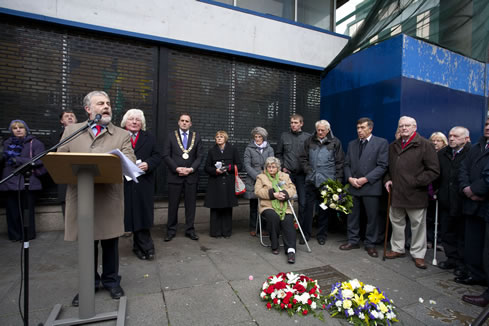
We gather on this cold December morning to remember those who lost their lives in the bombing of Sackville Place on the first day of December in 1972. Just minutes earlier that evening, a bomb shattered Liberty Hall just around the corner from here and outside the historic birthplace of the Irish Transport and General Workers Union.
These were the first car bombs to explode in the Republic bringing the armed conflict that erupted in the North just a few years earlier to this jurisdiction and reminding the people of Dublin that no-one on this small island was immune from the tumultuous and tragic events unfolding at that time.
George Bradshaw, aged 30, a bus driver, and a native of Fethard, Co. Tipperary and bus conductor Tommy Duffy, aged 23, were killed by the bomb that exploded here in Sackville Place. Both of them were married men. George and his wife, Kathleen, had two young children. Tommy and his wife had a daughter and Monica, who is present with other relatives of the deceased men here today, was pregnant with their second child. Many others were injured in the attacks. Some 127 people were injured, many seriously.
Liberty Hall, built in the mid 1960’s on the site from where James Connolly had led the Irish Citizens Army to the GPO on Easter Monday 1916 and where the Proclamation was printed had all of its windows blown out and suffered structural damage.
Only because the explosions took place just after 8.00 p.m. the hundreds of people that worked in Liberty Hall and the surrounding area narrowly escaped with their lives while the building continues to exhibit the devastating physical effects of the bombing.
Some weeks later on 20th January 1973, Tommy Douglas, aged 21, a bus conductor and a native of Stirling, Scotland died when another bomb exploded close to the CIE depot here in Sackville Place.
As I have mentioned the car bombs at Liberty Hall and Sackville Place were detonated at a politically sensitive moment in the history of those troubled times.
A controversial amendment to the Offences Against the State Act was being debated in the Dáil when the bombs exploded. A huge swathe of public opinion, including the ITGWU and the Labour Party, was against the introduction of what was perceived as draconian legislation and an attack on civil liberties.
There was also widespread opposition among other trade unions, hospital medical staff, staff and students of universities, mechanical workers in CIE, clergy and even some branches of Fianna Fáil, the party in Government that was introducing the legislation. Senator Fintan Kennedy the General President of the Transport Union and Michael Mullen its General Secretary had spoken against the legislation which they saw as a dangerous infringement on human rights.
In its statement the ITGWU asserted that while it ‘opposed political violence which is directed at civilians, we are equally opposed to the violence that is being done by the Government to democratic institutions and civilised legal procedures.’
As a direct consequence of the bombings the legislation was passed with members of Fine Gael, the main opposition party, abstaining that night in the Dáil vote and allowing the amendment to be passed.
Unsurprisingly, many of those who opposed the measure believed that the sinister forces behind the attacks were seeking to influence parliament, and succeeded in their objective, through these acts of terror which, and not for the last time, brought the horrific and daily scenes of destruction from the North to the citizens of Dublin.
Three minutes before the first bomb exploded, the Belfast Newsletter received an anonymous telephone warning that bombs planted at Liberty Hall and behind Clery’s here at Sackville Place would explode at 8.05 p.m. The person who received the warning said the caller had spoken with a ‘Belfast English-type accent’.Early investigations into the bombings centred around four cars. One car containing the owner’s driving licence had been stolen four months previously in Ballymoney, Co. Antrim. The stolen licence of an Englishman, Joseph Fleming, was used to hire three other cars from different Belfast companies on 30th November by a man with an English accent. Two of the hired cars exploded at Liberty Hall and Sackville Place.
The Gardaí were very pro-active in the early days of the investigation, travelling to Belfast and London to retrieve hire agreement documents and interviewing witnesses. Although the RUC were relatively helpful the Garda reported that RUC officers would not permit them to interview some persons ‘for reasons best known to themselves.’ Despite a promising start, the Garda enquiries led nowhere.
Notwithstanding the selfless and tireless work of Justice for the Forgotten, the group of relatives and survivors of the awful atrocities committed in this jurisdiction during the years of conflict, the identities of those responsible for the Sackville Place and Liberty Hall bombings remain unknown. Dáil motions passed in 2008 and 2011 called on the British authorities to release undisclosed documents which Justice for the Forgotten believes can help to throw light on those involved in these and other attacks, including the 1974 Dublin and Monaghan bombings which killed 33 people and an unborn child.
Today, however, is a time to remember those who lost their lives as a result of the tragic events of December 1972 and January 1973 at this place and those that they left behind.
Monica Duffy was just 22 and her husband Tom, just 23 when he lost his life. Married just over a year and eight months they had a daughter and Monica was four months pregnant with her second child. From Castlebar in county Mayo, Tom was a conductor on the 29a bus which travelled close to her home in Artane in the northside on its route from Abbey Street. That is how they met and fell in love. He was a member of the National Busworkers Union.
His colleague, George Bradshaw, was a member of the ITGWU, and his colleagues marched in sympathy from Liberty Hall just days after his death. Both workers had left the CIE canteen on Marlborough Street just moments before the explosion. George was a native of Tipperary, who lived in Sutton with his wife and two children.
A month later, on January 20 1973, another Dublin bus worker, Thomas Douglas, was killed when the bombers struck again at Sackville Place on a Saturday afternoon. The bombers were never caught and speculation has raged ever since as to the involvement of British intelligence services in collusion with Loyalist paramilitaries in these and later explosions.
Forty years later the families of those killed and the survivors of these attacks during the 1970s are still waiting for answers. As we gather there today to lay wreaths in memory of their loved ones we can only add our voices to those calling for the truth of what happened during those terrible years.
While peace has come dropping slow and has transformed relations on this island and between the people of Ireland and Britain justice still demands closure for those who have lost their loved ones including the families of Tom Duffy and George Bradshaw who died at this spot forty years ago this week and Thomas Douglas who lost his life on 20th January 1973. Finally, I would like to offer my condolences to the families of the three men who are gathered here today.